
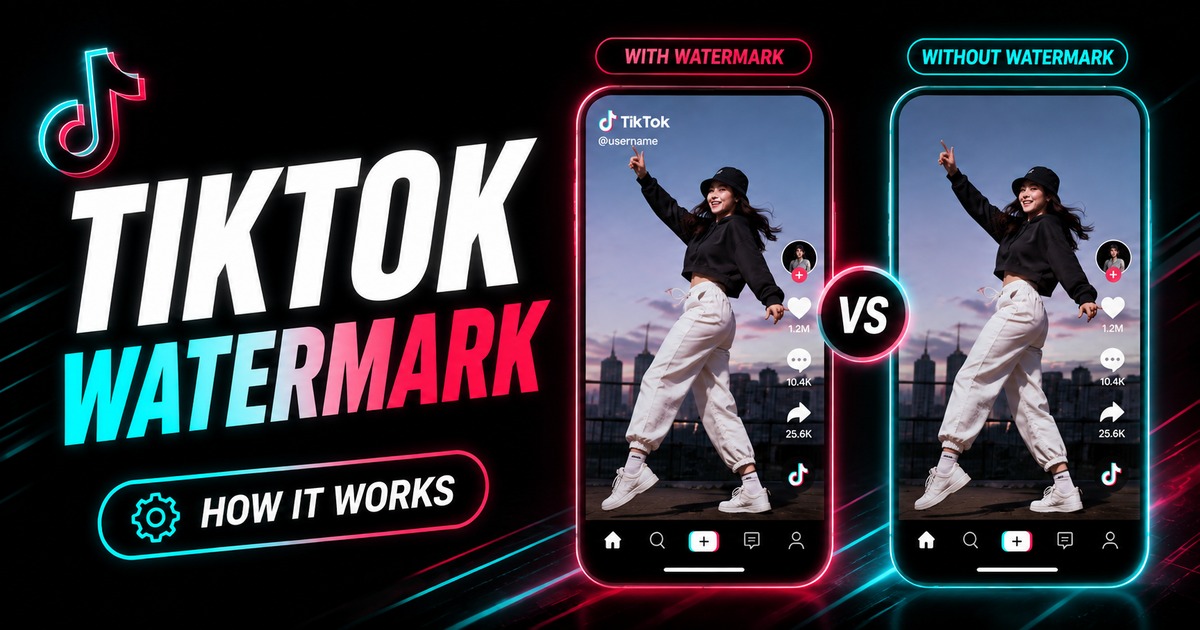
A TikTok watermark is easy to recognize but easy to misunderstand. It is a visible overlay in the video image, commonly identifying TikTok and creator/account context. It is not the same thing as the file's metadata, codec, or ownership record.
Understanding that distinction explains why some “watermark removal” methods reduce quality while a clean media variant does not require the overlay to be edited out frame by frame.
Why a watermark moves
A static mark in one corner is easy to crop or cover. A moving overlay changes position, making simple removal less reliable and reducing the chance that a single crop removes it without destroying a large portion of the frame.
The movement belongs to the rendered presentation. It does not mean the creator's camera source literally contains a moving platform logo in the original capture.
Visible watermark vs metadata
A visible watermark is made of pixels you can see.
Metadata is information stored in or associated with the media file, such as technical properties and sometimes descriptive tags.
Removing visible pixels does not necessarily remove metadata or other evidence of provenance. Likewise, deleting metadata does not erase a watermark that is already encoded into the image.
Three ways people end up with “no watermark”
1. A clean media variant
A suitable source/distribution variant is obtained without the visible overlay in that copy.
This is preferable because the video frames do not need to be modified.
2. Cropping
The marked region is cut away.
This is simple but permanently changes composition and can reduce the effective resolution.
3. Covering, blurring, or reconstruction
Software paints over, blurs, or reconstructs the marked region.
Results may look acceptable on a simple background but can create artifacts when the watermark crosses a face, text, hands, clothing, or detailed motion.
For a public TikTok post, the SnapVid downloader can present a clean media option when one is available, avoiding destructive visual editing of a watermarked copy.
Does a clean copy preserve attribution automatically?
No.
If the visible watermark is absent, the file may no longer display the creator's username inside the image.
If you are authorized to republish somebody else's work, follow the attribution requirements of that permission or license. If you are not authorized, removing a watermark does not create authorization.
Does the watermark affect compression?
A visible overlay adds some extra image detail for the encoder to represent, but the larger quality factors are usually:
- source quality;
- bitrate;
- codec;
- scaling;
- prior compression;
- platform processing.
Attempting to remove the watermark after the fact can cause more visible damage because it modifies surrounding pixels.
Best practice for creators
If the content is yours, export and archive a clean master before uploading.
That gives you a reliable cross-platform source without depending on any downloader.
If the original master is gone and the public post is still available, a clean distribution copy can be a useful fallback. Just remember that it may already include platform compression.
Read how to back up your own TikTok content for a better long-term workflow.
Watermark status is not a rights status
The presence or absence of the watermark does not decide:
- copyright ownership;
- permission to repost;
- commercial-use rights;
- music licensing;
- attribution requirements.
Those are separate questions.
See TikTok without watermark: what it means.
FAQ
Is a TikTok watermark part of the MP4 format?
No. MP4 is a media container. A visible watermark is typically part of the rendered video frames in that particular copy.
Can metadata removal erase the visible watermark?
No. Deleting metadata does not change pixels that are already encoded into the frames.
Does watermark-free mean copyright-free?
No. The absence of a visible mark says nothing about ownership or permission to reuse the work.
Is cropping a lossless watermark-removal method?
No. Cropping discards part of the image and changes framing.
Bottom line
Think of the TikTok watermark as a visual layer in a distributed copy, not a switch that changes ownership or makes a file an original master. When a clean media variant is available, it avoids destructive frame editing—but rights and attribution still need to be handled separately.