
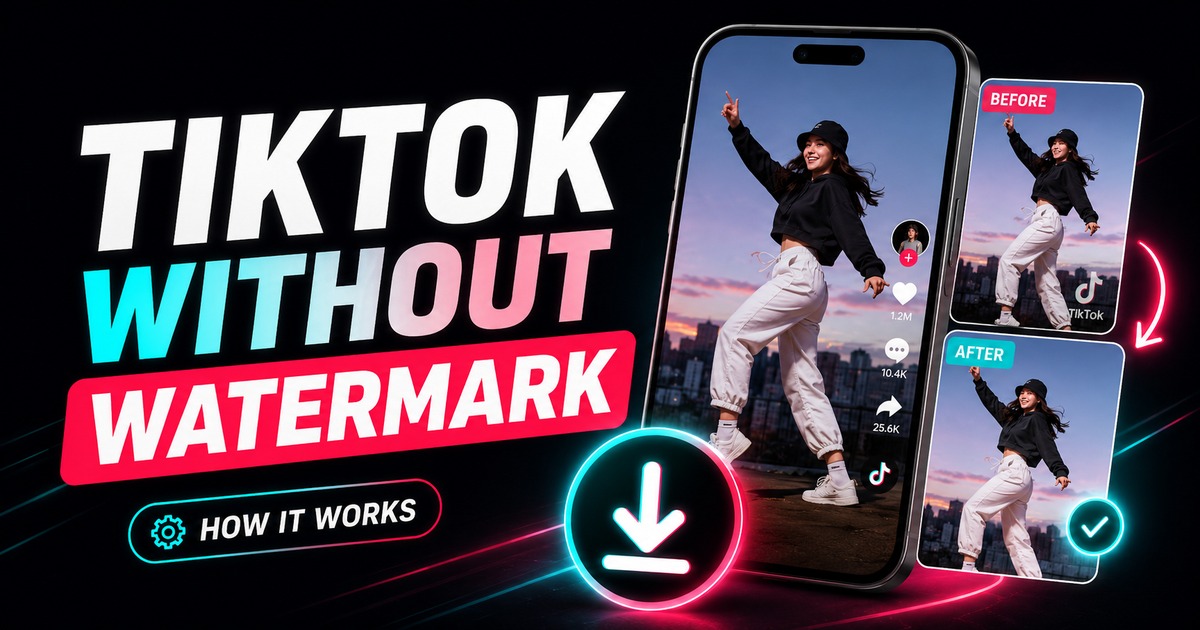
“TikTok without watermark” sounds simple, but two very different processes are often grouped under that phrase. One retrieves a clean media variant associated with a public post. The other starts with a watermarked copy and tries to erase, blur, crop, or cover the overlay.
Those methods have different consequences for quality, framing, and authenticity.
What the TikTok watermark does
The familiar TikTok overlay helps identify the platform and commonly includes creator/account context. It is part of the rendered copy users often see in platform save/share flows.
A visible watermark is not the same thing as metadata. Removing the visual mark does not erase every trace of a file's origin, and it does not change copyright ownership.
Clean source vs visual watermark removal
A clean-source workflow obtains a media variant before the visible overlay has been burned into that specific copy.
Traditional watermark removal starts with a marked video and modifies the image afterward. Common techniques include:
- cropping;
- covering the mark with another graphic;
- blurring;
- reconstructing pixels with inpainting.
Every one of those techniques changes visual information. Cropping can destroy composition; covering replaces one overlay with another; inpainting can create artifacts.
For public posts where a clean media variant is available, retrieving that variant is usually better for preservation than altering every frame.
Does watermark-free mean “original quality”?
No. “No watermark” describes the visible overlay, not the complete encoding history.
A clean-looking clip can still have:
- a lower bitrate than the creator's camera original;
- platform recompression;
- scaled resolution;
- altered audio encoding;
- previous re-encoding from another app.
If quality matters, evaluate the actual media properties rather than treating “without watermark” as a synonym for “master file.”
See why TikTok downloads can look worse.
Why creators may want a clean copy
Creators sometimes need a clean copy of their own published work for editing, cross-posting, portfolio use, or backup.
Even then, the best archive is the pre-upload camera/editor master. A file retrieved from a social platform should be treated as a distribution copy or fallback, not the only master.
If the video belongs to somebody else, a clean copy does not automatically give you permission to republish it without attribution or use it commercially.
What SnapVid does
For a public TikTok link, the SnapVid TikTok downloader presents the media variants it can resolve for that post. When a clean option is available, you can use it rather than editing a watermark out of an already-rendered video.
Availability can vary by post and can change as TikTok changes its media delivery. SnapVid should not be treated as a way to access private or inaccessible content.
Watermark myths worth avoiding
“No watermark means nobody can identify the source”
False. Visual content, captions, audio, repost history, hashes, and other context can still indicate provenance.
“Removing a watermark makes reposting fair use”
False. Legal exceptions depend on context and jurisdiction; a technical edit does not create permission.
“Cropping is lossless watermark removal”
False. Cropping discards pixels and changes framing.
“A larger exported file is more original”
False. Re-encoding can increase file size while reducing quality.
When a clean copy is useful
Legitimate uses can include:
- preserving your own published work;
- moving your own content into an editing workflow;
- creating an authorized compilation;
- keeping public media that you have permission to archive.
The important distinction is technical ability versus usage rights. A downloader can obtain a file; it cannot decide whether your intended reuse is authorized.
FAQ
Does SnapVid erase the watermark frame by frame?
The preferred workflow is to present a clean media variant when one is available rather than visually painting over a watermark in each frame.
Is a watermark-free TikTok always HD?
No. Watermark status and resolution are separate properties.
Can I remove a watermark from a private video?
A public-link downloader is not intended to access private content. If the video is yours, use your original files or TikTok's own account features.
Does a clean copy become copyright-free?
No. Copyright and permission do not depend on whether a visible watermark is present.
Bottom line
The useful meaning of “TikTok without watermark” is a clean distribution copy when one is legitimately available, not a promise that the file is the creator's original master or that ownership rules disappear. Use the TikTok downloader for public posts and respect the creator's rights when you reuse the result.